Get more learners to the credential, with the evidence to show it.
Practice built from your own curriculum, scored by rules against an approved rubric. Every hour and sign-off counts toward what your agency or accreditor requires, and the report comes out in the agency’s own columns.
See it work
RTI hours, sign-offs, the agency report and a curriculum to start from, on real screens.
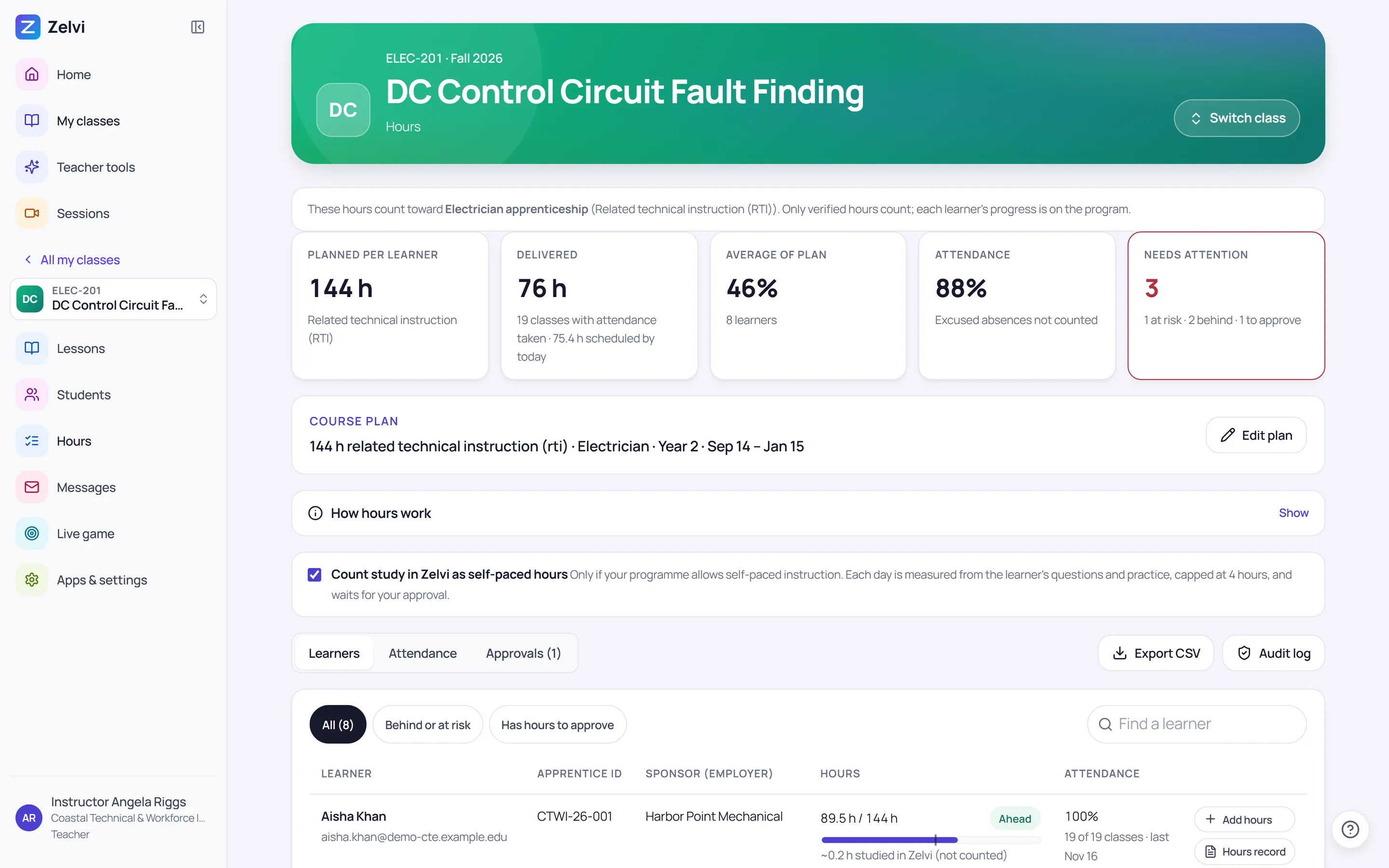
A 55-second walkthrough of real Zelvi screens on a demo institution:
- An RTI class keeps its register in Zelvi: attendance, check-in and instructor sign-off
- Hours delivered against the plan, attendance, and who needs attention
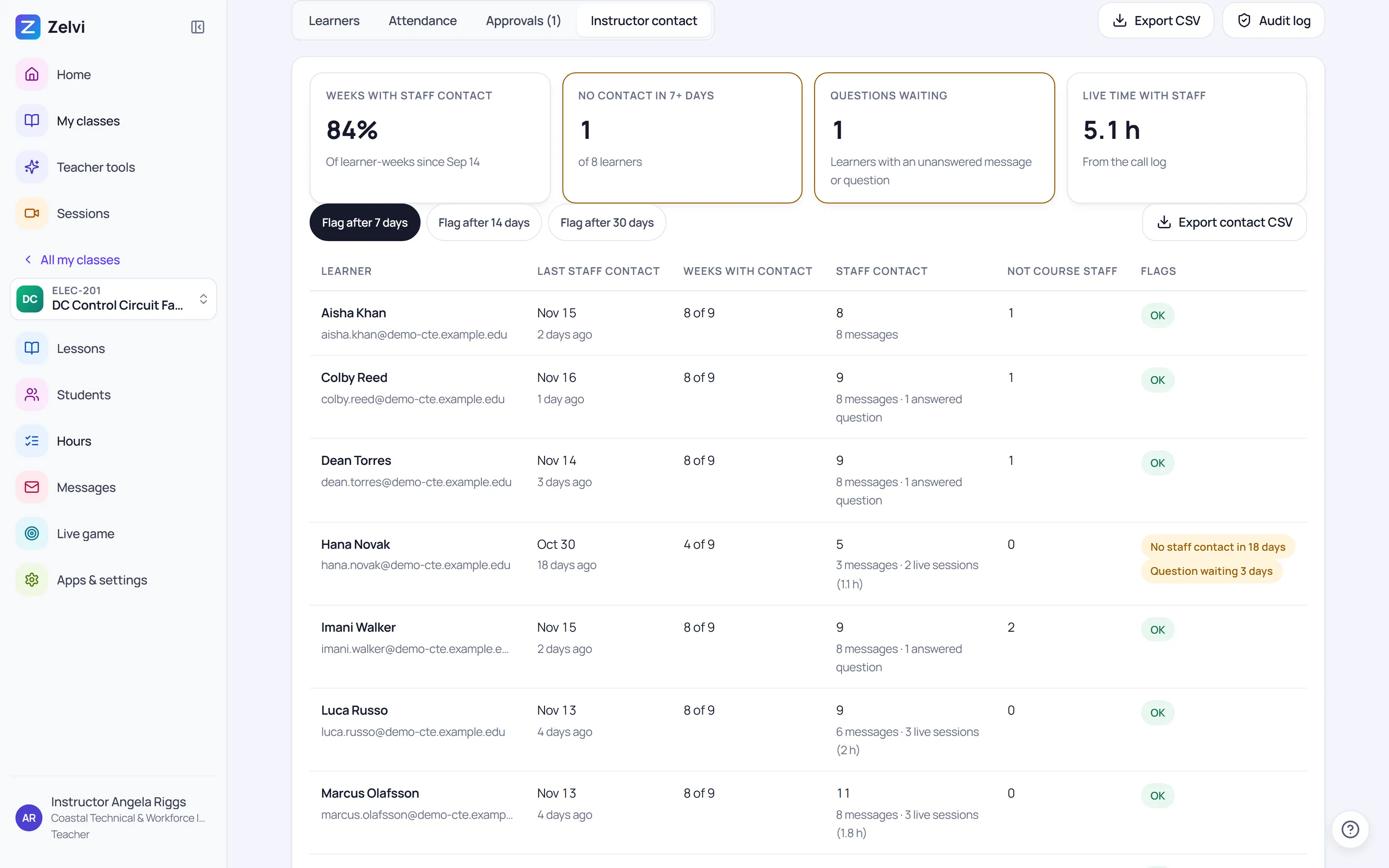
- Instructor contact between classes: messages, answered questions, marked work and live time from the video call log
- An apprentice no instructor has reached in 18 days, with a question waiting, is flagged
- The program adds up every course that counts toward RTI
- Each apprentice against their own year, from their registration date: RTI toward 144 h, OJT toward 2,000 h
- Behind this year, or short in an earlier one, flagged while there is time to catch up
- Year by year: required, counted and what is still due
- On-the-job hours, signed off month by month by the sponsor’s journeyworker
- Year-1 RTI from a college transcript, transferred in with the reason. Nothing can be edited afterwards
- Sponsors sign from an emailed link, with no account. Each link works once
- The apprentice sees the same numbers, and can ask their sponsor to sign
- Exports from the same numbers: RAPIDS-style, cohort by sponsor or region, WIOA
- Match the agency’s own upload template once: its headings, its order, its date format
- Every quarter after that, the file comes out in that layout, ready to upload
- A signed progress record for each apprentice, as a page or a PDF
- Or give the agency a read-only link: IDs instead of names, an expiry date, every view logged
Real product screens on a demo institution. The learners and their work are synthetic.
Hours, sign-offs and agency reports
What your agency asks for, kept as the hours happen.
- RTI hours per apprentice, by apprenticeship year
- Counted from each apprentice’s registration date, not the school year, against the hours in your registered standards (federal rules recommend 144 a year). Hours from every course that counts are added up, and prior RTI from a college transfers in with the reason on the record.
- Proof the hours happened
- Class registers with check-in, instructor sign-offs, hours a learner reports and staff approve, and study in Zelvi only where your program allows it and staff approve each day. Verified hours, pending hours and study time are kept apart, and only verified hours count.
- On-the-job learning and skills, signed by the sponsor
- The sponsor’s journeyworker, supervisor or preceptor signs from an emailed link, with no account. The link works once, and the sign-off cannot be edited afterwards.
- Early warning, while there is time to act
- Learners who are behind for the year, or short in an earlier one, are flagged on the program screen, and the learner sees the same numbers on their own page.
- Proof of instructor support between classes
- An instructor contact report for each course: when an instructor last reached each apprentice, in how many weeks, and how, by message, answered question, marked work or a live session timed from the video call log. Apprentices nobody has reached for a week, or with a question waiting, are flagged. Tutors are shown separately and the AI tutor never counts.
- The report to the agency
- RAPIDS-style apprenticeship progress, Perkins V and WIOA exports, and cohort summaries by sponsor, site or region. Paste the heading row of the agency’s upload template once and every later file comes out in that layout.
- Records for an audit, a transfer or a completion
- A progress record for each learner as a page or a PDF, with signature lines, and a read-only link for the agency that shows IDs instead of names, expires, and logs every view.
- Help between classes
- A tutor built from the program’s own material, by text or voice in 22 languages, that cites the page and keeps the trade’s English terms beside the translation, so an apprentice is not stuck until the next class.
- A curriculum to start from, for a trade you are adding
- Open starter curriculum for electrical apprenticeship, solar PV, nurse aide and phlebotomy: syllabi, program outlines, lab manuals, a nurse aide handbook and skills checklists from openly licensed (CC BY) college programs funded by the Department of Labor. Your staff copy one into your organization as drafts, add their own lessons, set its hours and publish once your instructor has reviewed it. Every file keeps its source and licence, and opens as the original document beside each answer.
Zelvi produces the agency’s file and your staff upload it to RAPIDS or the state system; there is no direct connection. Template numbers are starting points that show their source, and you confirm them against your registered standards before they count. The starter curriculum is a starting point too: your instructor reviews it, and your organization stays the provider of record.
How Zelvi works here
A mistake today. Fixed by tomorrow.
- 1
Student
Gets it wrong
Zelvi names the exact mix-up and re-teaches it with a picture, from your own lesson. Then they try again.
- 2
Instructor
Sees who is stuck
One colour map of the class: who has it, who needs help, and the ideas the class is stuck on.
- 3
One click
Fixes it tomorrow
A short check aimed at those exact steps, and a re-teach group for the people who missed them.
Who gains what
One platform. A win for everyone who touches it.
CTE directors, workforce boards and training managers
Hit the credential and completion counts your funding depends on.
Competency evidence by program, scored by rules against your approved rubric and traceable to the document behind every criterion.
Instructors and trainers
One instructor, every learner’s sticking point.
Your own procedures turned into step-by-step lessons, and a view of which step each learner keeps getting wrong.
Supervisors and safety leads
Sign off with a record you can audit.
Every result names the rubric version and the source document it was judged against, so a sign-off can be followed back.
Learners and apprentices
Learn the why, at their own pace, on any shift.
OSHA 10 and CompTIA A+ prep, procedures one step at a time, and a tutor in 22 languages that answers from the program’s own material.
The budget case
Not just student support. A line in your budget you can defend.
For CTE directors, workforce boards and training managers
Perkins V and WIOA count credentials earned, and employers pay for finishers, not for starts.
- More students who earn their credential, each year
- 10
- Funding and tuition kept, each year
- $35,000
- Over a 3-year contract
- $105,000
Where the budget often sits: Perkins V · WIOA · Employer-sponsored training
Your numbers and your assumption; the defaults are examples. Zelvi has no efficacy data yet, so we do not pick the share for you. A pilot sets your baseline from your own records, and your grant office decides what is allowable under each award.
Working today
What you get on day one.
- Evidence competency for accreditation and programme review.
- Keep every rubric criterion traceable to the source document.
- Spot the students who will struggle at the practical before they get there.
- Count RTI, work-based learning and clinical hours per learner, from their own start date, against what the agency requires.
- Give the state agency its quarterly report in its own upload layout, without retyping a spreadsheet.
Answers cited back to your own material, with the instructor one tap away when the material does not cover it
Every procedure step and rubric criterion carries a reference back to the document it came from
Competency is scored by rules against an approved rubric, not by a language model’s opinion
Instructors attach their own documents to a course, review them as a draft, and publish when ready
See which learners are struggling and which concepts they are stuck on
Hours recorded where they happen: class registers with check-in, instructor sign-offs, hours a learner reports and staff approve, and study in Zelvi only where the program allows it
Open curriculum library
Programs we are built for
Other kinds of institution